
Middlesex Release Dates Explained
A scheduled, tentative, or projected release date is a date shown from the facts then in the official system. It is not proof that the person walked out that day. Connecticut DOC warns that inmate information is updated daily, can change fast, and may not reflect an immediate event. An actual release date records that physical custody ended. A discharge date may mark the end of a sentence or DOC supervision. Parole can end confinement while supervision continues.
The distinction is sharp for Middlesex County. Hartford Correctional Center serves Middletown superior court matters and holds mainly pretrial people. A pretrial detainee has not yet received a final sentence that can be reduced to a set release date. Bond posted, bond changed, dismissal, a promise to appear, or another court action can cause release. A sentenced DOC inmate has a term that may support an end-of-sentence or other release-date field.
- Projected date
- A current estimate based on the sentence, credits, and known legal events.
- Parole eligibility
- The point when a qualifying case may be considered for parole, not an automatic release day.
- Detainer
- A lawful request or order that may keep a person in custody for another case or agency.
- Discharge
- The end of the controlling sentence or supervision status as recorded by the responsible agency.
Note: A Middlesex court disposition can explain the legal basis for release but may not show the facility's physical release time.
Find Middlesex Inmate Release Dates
Begin with the CT DOC Inmate Search landing page, which links to the official inmate information tool. Use a CT DOC number if known. Search-result guidance says an inmate number or the first few letters of the last name can improve the search. Compare more than the name. Age or birth details, current facility, sentence data, and court context help prevent a false match.
Record the exact field label shown. The research could not verify one universal live label because the record view restricted automated access. Depending on the record, useful wording may include release date, projected release date, tentative release date, end-of-sentence date, parole date, discharge date, or status. Do not rename one field as another. The official CT DOC inmate information search is the source that controls its displayed wording.
- Identify the person by CT DOC number, name, and public birth or age details where available.
- Read the current facility, custody or supervision status, controlling sentence information, and displayed date fields.
- Check the Judicial Branch criminal docket for the Middlesex sentence, bond order, mittimus, or later modification.
- For parole timing, read the BOPP decision and distinguish eligibility, an on-or-after date, and physical release.
- If the date is missing or unclear, contact CT DOC Public Information or request the public custody and release record through DOC FOI.
The broader named-person workflow and records-request route appear on the Middlesex County released inmates page. Use it when the live record no longer returns a match.
Middlesex Pretrial Release Has No Schedule
A Middletown court hold at Hartford Correctional Center does not work like a fixed prison sentence. The person may remain until bond is posted, the court changes the bond, a judge orders release, the case ends, or another lawful event occurs. If another docket or detainer exists, release on the Middlesex matter may not end custody. That is why adding a booking date to an assumed term gives a false answer.
Check the Connecticut criminal and motor-vehicle case lookup for the legal event. A docket can show bond, disposition, sentence, probation, or a mittimus, which is the court order sending a person into correctional custody. Pair that docket with CT DOC status. One shows the court action. The other shows the correctional status.
If a short sentence is imposed with credit for time already served, release may follow court and facility processing. The public docket can show the sentence and relevant event, but DOC or the facility should confirm that custody ended. Multiple dockets can change the outcome. Never assume the Middlesex case is the only controlling case.
Note: Hartford Correctional Center is a state DOC facility serving Middletown court matters, not a Middlesex County sheriff jail.
Connecticut Credits Change Middlesex Dates
Sentence credits can affect a sentenced inmate's timeline, but they should not be calculated from a short public summary. Connecticut General Statutes Chapter 320 contains the state correctional credit laws. Section 18-7a addresses good-conduct credit for older offense-date categories. It is not a general promise of credit for every modern sentence.
Section 18-98e governs risk-reduction earned credits. It authorizes the correction commissioner to award eligible people no more than five days per month, subject to statutory limits and DOC administration. Eligibility, award, loss, and application depend on law and the person's record. A displayed date may move when earned credit changes or when DOC corrects how jail credit was applied.
Jail credit for qualifying pre-sentence confinement can also matter. So can the offense date, effective sentence, multiple dockets, discipline, sentence modification, and special parole. These parts do not reduce to “sentence length minus good time” for every Middlesex County inmate. Use the displayed DOC date and request the official calculation when a precise record is needed.
The statute page is captured below from its official Connecticut source.
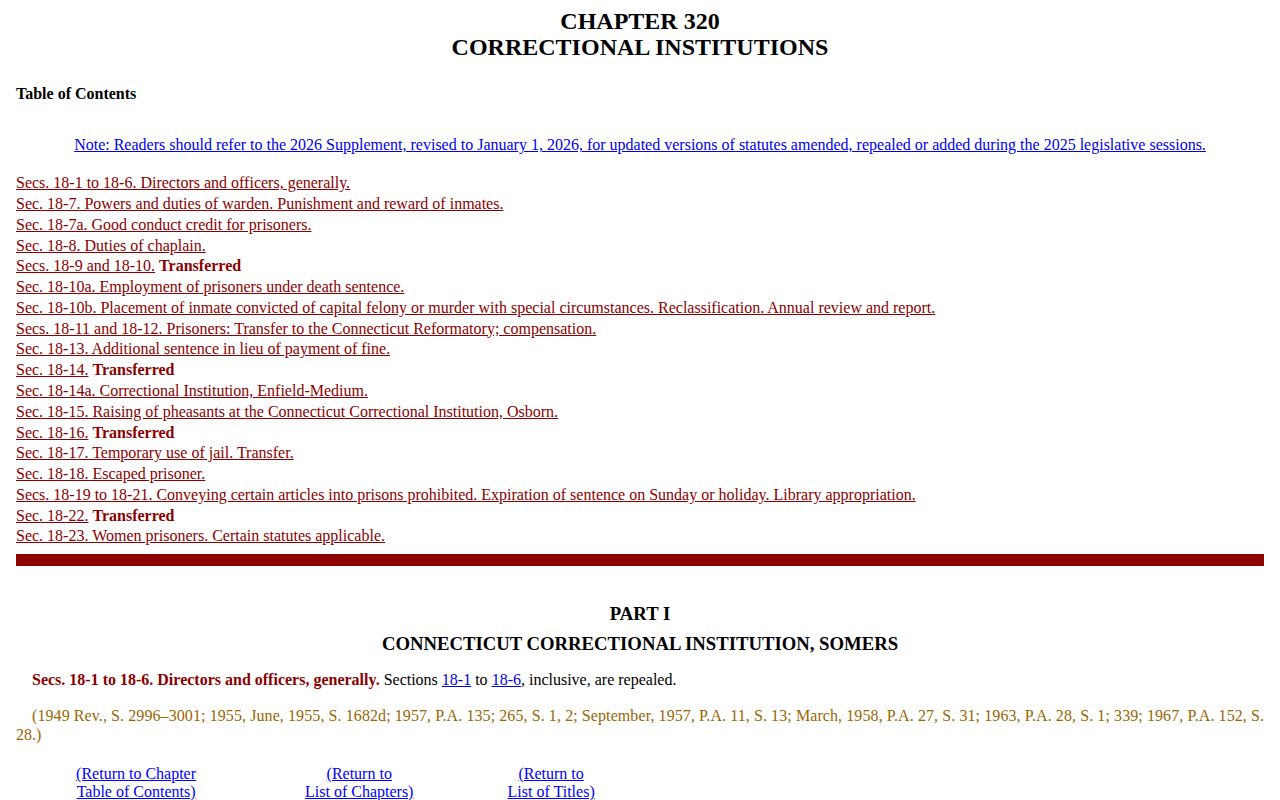
It supplies the legal framework, while CT DOC applies the relevant provisions to the actual sentence record.
Middlesex Parole Eligibility Is Not Release
Connecticut General Statutes Section 54-125a sets parole eligibility rules. For many eligible definite sentences, the Board may hold a suitability hearing after 75 percent of the definite or total effective sentence, less risk-reduction credit where the law permits. A listed statutory category uses an 85 percent threshold. Those percentages mark a possible parole consideration point. They do not guarantee a hearing outcome or release.
The Connecticut Board of Pardons and Paroles decides suitability. It may grant release to parole, deny with no further review, or deny and set a later hearing. A grant creates an on-or-after date. That is the earliest possible day, not an appointment for a fixed exit. Release plans and other arrangements still must be coordinated. If the person is not paroled, the controlling DOC sentence and discharge framework remain in place.
Special parole also needs care. A court imposes it as a post-incarceration term. It can appear in the sentence and later DOC or BOPP status, but its start does not mean all legal supervision ended. Compare the court judgment, DOC record, and BOPP action before describing the Middlesex County release date.
Note: Seventy-five and eighty-five percent are statutory eligibility concepts, not formulas for predicting a Middlesex County inmate's exact release day.
Why Middlesex Release Dates Change
A release date can change for more than one reason. Some changes come from the sentence calculation. Others arise from a new legal event or a parole decision. CT DOC's daily update warning means a web result can also lag behind a facility action. Check the source again near the expected day, then seek written confirmation when the date matters to a court or personal plan.
| Factor | Possible effect | Source to check |
|---|---|---|
| Jail-credit recalculation | Moves the end-of-sentence calculation | CT DOC and sentencing docket |
| Earned-credit award or loss | Changes an eligible calculation | CT DOC record and Sec. 18-98e |
| New charge or detainer | May keep the person in custody after one matter ends | Court dockets and holding agency |
| Parole action | Can grant, deny, defer, rescind, or modify a release path | BOPP decision and FAQ |
| Sentence modification | Changes the legal sentence or effective term | Judicial Branch docket and order |
| Transfer or data lag | Changes location or delays the public display | CT DOC and facility |
| Clerical correction | Corrects a wrong or incomplete displayed field | CT DOC Public Information or FOI response |
Federal dates are separate. A person in federal custody must be checked through the Bureau of Prisons. Connecticut credits and BOPP parole rules do not set a federal release date. A CT DOC result also excludes people held for federal immigration custody, so a missing state result is not proof of release.
Middlesex On-or-After Release Dates
The most distinctive Connecticut timing rule is BOPP's “on or after” date. The Board's parole FAQ says a voted-to-parole date is the first day release may occur. It is not the exact day. Community placement, required plans, and other release arrangements can take more time, even after the favorable vote.
The Board can rescind or modify its decision before physical release. New information, institutional discipline, new charges, or failure in a required program may affect suitability. The result can be a later date or no parole release under that decision. For a Middlesex County family or court contact, the sound practice is to treat the vote as a key milestone and the facility release record as proof of actual release.
The official FAQ and decision explanation is shown here.
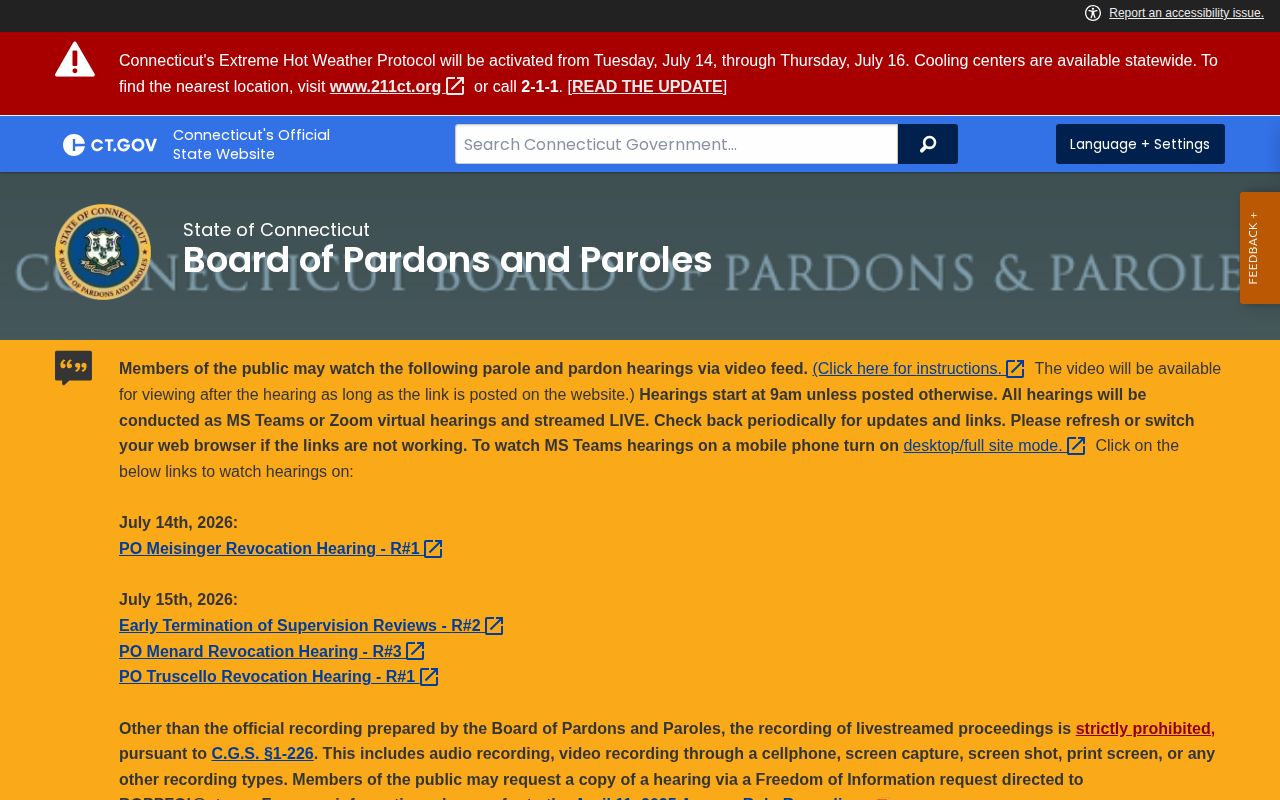
The page explains why a parole vote and a physical Middlesex-related release must be recorded as two distinct events.
Confirm Middlesex Actual Release Dates
Near the expected day, run CT DOC again and save the status, displayed date, and check time. If the person was held at Hartford Correctional Center, the facility or CT DOC can address physical custody. Use the Middlesex docket to see whether a court event changed the basis for the hold. If parole is involved, compare the BOPP action with the DOC custody record.
Connecticut VINE can send a release or custody-change notice for a person in a covered feed. Registration is useful, but VINE is not a full release archive and can reflect data lag. The Middlesex VINELink Release Check explains identity matching, alert channels, and the state re-registration rule.
For written proof, contact CT DOC External Affairs Freedom of Information. Ask for records sufficient to show the public release date, release type, facility, custody status, and applicable discharge or parole status. Include the full name, CT DOC number, facility, approximate custody dates, and Middlesex docket if known. A narrow request gives the agency a clear record to locate.
Do not equate “not found” with “released.” A miss can result from spelling, a full discharge, rapid data change, an exclusion, erasure, or the wrong custody system. Confirm the responsible agency first. Then rely on the record it created.