
Middlesex Parole and Probation Compared
A person can be released from physical custody yet remain under legal supervision. In Connecticut, parole is community supervision after release from a correctional sentence. The Connecticut Board of Pardons and Paroles makes parole decisions, while the Department of Correction Parole and Community Services Division manages community supervision. Special parole is also post-incarceration supervision, but the court adds that term to the sentence. Probation is different. It is ordered by the court, often with a suspended sentence or a disposition that does not require more time in a correctional center.
Middlesex County has no sheriff-run jail system or county parole office. A Middletown court matter may lead to custody at Hartford Correctional Center, then to probation, parole, transfer, or full discharge. The agency named in the order or status record determines where to verify it. The comparison below keeps the paths separate.
| Status | Who orders it | Best Middlesex verification path |
|---|---|---|
| Parole | Board of Pardons and Paroles | CT DOC inmate information, BOPP records, and DOC parole channels |
| Special parole | Sentencing court, followed by BOPP/DOC oversight | Court sentence, CT DOC status, and BOPP |
| Probation | Connecticut Judicial Branch court | Middlesex criminal docket and Middlesex Adult Probation |
| Discharge | End of the controlling custody or supervision term | CT DOC status, court record, or an official records response |
Note: Leaving Hartford Correctional Center does not by itself show whether Middlesex County parole, probation, or another legal obligation remains.
Verify Middlesex Post-Release Supervision
Start with the exact person and docket. The official CT DOC inmate information search is the main correctional lookup for a Middlesex County person who was held by Connecticut DOC. Search by CT DOC number when known because it is more exact than a name. A result may show incarceration, parole, special parole, a release or discharge date, or another status. CT DOC says the database is updated daily and may change fast, so save the date and time checked.
Probation may not appear in that database. It is a court-supervised status. Use the Judicial Branch criminal and motor-vehicle case lookup to identify the Middlesex docket, sentence, and probation order. Then contact the correct office. If a record says parole or special parole, switch to BOPP and DOC parole sources. If the online record is unclear, the released-person search and release-record request paths are covered on the Middlesex County released inmates home page.
- Confirm the full name, CT DOC number, birth information where public, and Middlesex docket number.
- Check CT DOC for current custody, parole, special parole, release, or discharge wording.
- Open the court docket to read the sentence, suspended portion, probation term, and later court events.
- Match parole questions to BOPP or DOC Parole and Community Services; match probation questions to Middlesex Adult Probation.
- Ask the responsible office for public confirmation when the web sources conflict or omit the status.
Middlesex Probation Office After Release
Middlesex probation has a local route that is separate from state parole. The Middlesex Judicial District page lists Adult Probation at the courthouse contact number. Connecticut 2-1-1 places Middlesex Adult Probation at 484 Main Street in Middletown and gives weekday office hours. This is the right starting point when a Middlesex judgment shows probation, a suspended sentence with probation, or a court order assigning supervision.
Do not ask the probation office to interpret a CT DOC parole result. Likewise, BOPP does not replace the local court record for a probation term. Bring the docket number when contacting Adult Probation. A common name alone can point to the wrong case. The office may also limit what it can disclose, so a public docket remains useful for the length and terms that the court made public.
Middlesex Adult Probation
484 Main Street
Middletown, CT
Phone: (860) 344-2998
Hours: 8:30 a.m. to 5:00 p.m.
Board of Pardons and Paroles
55 West Main Street, Suite 520
Waterbury, CT 06702
Phone: 203-805-6605
BOPP parole resources
Note: Middlesex Adult Probation verifies court probation, while BOPP and DOC channels address parole and special parole after release.
Middlesex Parole Hearings and Decisions
The BOPP hearings page publishes current public links and schedule information. BOPP states that hearings can occur Monday through Friday and generally begin at 9 a.m. unless a posting says otherwise. Hearings use a video link between the institution and the Board, with a three-member panel and a parole officer. Public viewers may use the posted livestream, while future dates are available through the hearing and event calendar.
A hearing does not promise release. The panel may vote to parole, deny with no further consideration, or deny and set a later hearing. Written and oral reasons accompany a denial. A grant sets an on-or-after date, which is the earliest possible release day. Arrangements can push physical release later. New charges, discipline, new facts, or a program problem can also cause the Board to rescind or modify the decision before release.
The hearing page bars unofficial screenshots and recordings of proceedings under Connecticut General Statutes Sec. 1-226. A public copy of an official recording may be requested through BOPP FOI. That rule matters when documenting a decision: use the Board record, not a captured livestream frame.
The BOPP public hearing information page shows how the process is organized.
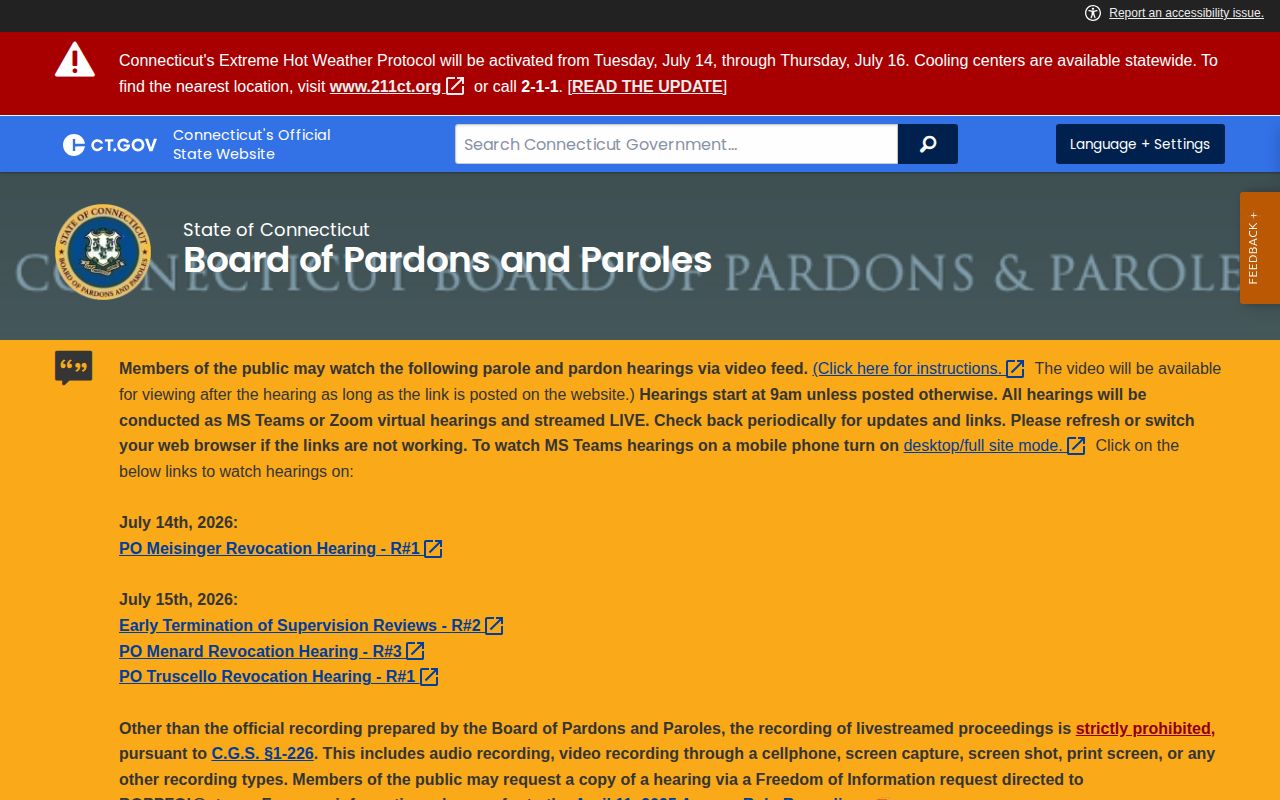
Its statewide hearing structure is the official parole route for a Middlesex County person in DOC custody, not a county board process.
Middlesex Supervision Violations and Absconding
BOPP separates criminal violations, technical violations, and absconding. A technical violation breaks a supervision rule without necessarily being a new criminal charge. Absconding means a person has failed to keep contact with the parole system. Neither label should be inferred from a missing search result. Use an official status, warrant, court, or BOPP record.
If DOC Parole and Community Services returns a person to custody, it sends the Board a violation report that also starts the warrant and revocation process. The final panel may return the person to parole, revoke parole and allow later re-parole or review, or recommit the person for the unexpired sentence. A probation violation follows the Judicial Branch path instead. The Middlesex docket can show an alleged violation, warrant event, hearing, or later disposition.
Conditions vary by order and should not be guessed. They can concern reporting, approved residence, travel, treatment, or conduct, but only the signed order and supervising office establish the actual terms. For a pending custody change, Connecticut VINE may provide an alert if the person remains in a covered feed. It does not decide whether a violation occurred.
- Absconder
- A supervised person reported as failing to maintain required contact with parole authorities.
- Remand
- A return to correctional custody under legal authority while a violation is addressed.
- Revocation
- A decision ending parole status and possibly returning the person to custody.
- Discharge
- The end of a custody or supervision term, as shown by the responsible agency.
Note: A parole warrant, probation warrant, and new criminal case are distinct records and may follow different Middlesex verification paths.
IDs After Middlesex County Release
Identification left in custody has a Connecticut-specific recovery route. Connecticut 2-1-1 advises contacting the releasing facility when fewer than 30 days have passed. That means a person released from Hartford Correctional Center should start with that facility, not the Middlesex probation office. The facility can explain whether it still holds the document and what identity checks are needed for return.
After 30 days, the source directs inquiries to the DOC Reentry Services Unit at 860-692-7869. Personal identification is kept at Central Office for two years. This rule concerns stored identification, not a parole or probation record. It is still vital after release because missing documents can make it hard to report, keep appointments, or complete a verified handoff to the correct supervision office.
The source is the Connecticut 2-1-1 identification retrieval notice. Give the facility name, release date, and DOC number when known. Do not send private identity data through an unrelated web form. The facility or Reentry Services Unit should state the secure method.
Middlesex Supervision Discharge Records
Supervision ends through the authority that imposed or managed it. A completed probation term may be reflected in the Middlesex docket and Judicial Branch records. A parole or special parole discharge belongs to DOC and BOPP records. An early-termination review, revocation decision, or final discharge can change what appears in a live correctional search. Preserve the source and date because CT DOC says its data can change quickly.
Connecticut FOI law, including Sections 1-210 and 1-212, supports requests for nonexempt public records. It does not open every supervision file. Personal, erased, sealed, safety-sensitive, juvenile, and other protected material may be withheld. A focused request for the public supervision status, agency, start date, end date, and discharge record is more useful than a broad demand for a full file.
A missing result does not prove discharge. Search errors, an alternate spelling, a separate docket, data lag, or a record restriction can also explain the gap. Confirm probation with the Middlesex court and Adult Probation. Confirm parole with CT DOC and BOPP. When both systems show no active obligation, ask the originating office for a public record if written proof is required.