
No Middlesex 72-Hour Release List
No official Middlesex County source posts a rolling three-day list of names, release times, or booking photographs. The county has no modern sheriff-run jail roster. Hartford Correctional Center, a Connecticut Department of Correction facility, serves Middletown Superior Court matters and is the most relevant live facility for many Middlesex pretrial holds. A release from that facility is tracked through statewide and court records, not a county page.
A three-day review must therefore be reconstructed for a known person. Begin with the CT DOC inmate information search. Then compare the result with the Judicial Branch case record and any VINE notice. Note each check time. The purpose is not to create an unofficial public list, but to determine whether a specific custody status changed within the lookback period.
Build a Middlesex Three-Day Review
The best 72-hour method uses snapshots. A single current result only shows what the source says now. Three dated checks make changes easier to see, but every snapshot remains subject to the source’s update cycle. Use a CT DOC number when possible, because name-only searches can miss spelling differences or match the wrong person.
- Write down the start and end of the 72-hour period in local time.
- Search CT DOC by inmate number or name. Record the facility, status, release field, and check time.
- Review the Connecticut criminal and motor-vehicle case lookup for Middlesex docket activity during the same dates.
- Check Connecticut VINE for a custody-change notice if the person was registered in a covered feed.
- Repeat the official checks on later days in the window rather than relying on a saved old screen.
- Request CT DOC or court records if the sources conflict or the exact release fact is needed.
This process is wider than the same-day workflow. It compares a sequence rather than asking only what changed today. For a focused current check, use the Middlesex County released last 24 hours page.
Middlesex 72-Hour Release Fields
There are no county-feed fields to reproduce. Instead, use a small comparison log drawn from the official sources. Keep legal events separate from correctional events. A court can order release or modify bond, while facility processing or another active hold can affect when the person actually leaves.
| Field to record | Why it matters over 72 hours |
|---|---|
| Person and CT DOC number | Keeps all daily checks tied to the same person. |
| Date and time checked | Defines each snapshot in the three-day period. |
| Facility or location | Shows whether a state facility remained listed. |
| Custody or supervision status | May reveal a move from incarceration to parole, special parole, release, or discharge. |
| Displayed release date | Provides the source’s date, which may be tentative or later corrected. |
| Court event | Explains a bond, disposition, sentence, or other legal change. |
| VINE notice | Records a participating custody-status notification, not a full release archive. |
Also save the source name. A CT DOC status, VINE alert, and Judicial Branch docket are related but not interchangeable. Only the holding agency can supply a definitive physical release record when the public views do not agree.
Note: A 72-hour review is a set of dated official checks, not an archived Middlesex County recent-release feed.
Middlesex Weekend Release Delays
A three-day window is useful because it can bridge a weekend or holiday. Yet the research identifies no special Middlesex weekend release schedule, courthouse release cadence, or guaranteed posting hour. Do not assume that a Friday court event will appear as a physical release at once. The person may remain held while an order is processed, while another docket is reviewed, or while a detainer is resolved.
CT DOC states that its public inmate information is updated daily and can change quickly. The Middlesex Judicial District clerk’s public office hours do not turn the online docket into a live jail feed. A court entry made within the period may explain the release authority, but the time posted and the time the person left can differ.
If the lookback crosses closed-office hours, make a new CT DOC check after the period and contact the proper office on the next business day. Ask for a narrow record showing the date, release type, and facility. This is more reliable than assigning the release to the day an online result disappeared.
Middlesex Release Records Drop-Off
The Middlesex roster quirk becomes more visible over three days. A person can drop from a live state search without entering any county archive. Someone who remains on parole or special parole may still appear under supervision, while a fully discharged person can be harder to locate online. “Not found” therefore has several possible meanings.
The search may have the wrong spelling or identifier. The person may never have entered CT DOC custody. CT DOC also says its database does not include youthful offenders or people held for federal immigration authorities. Erasure or sealing may restrict a court record. Recent data may simply lag. The correct response is to check the source boundaries, not to infer release.
The CT DOC inmate information page provides the daily-update warning and the Public Information Office route. It is also a matching source for the image below.
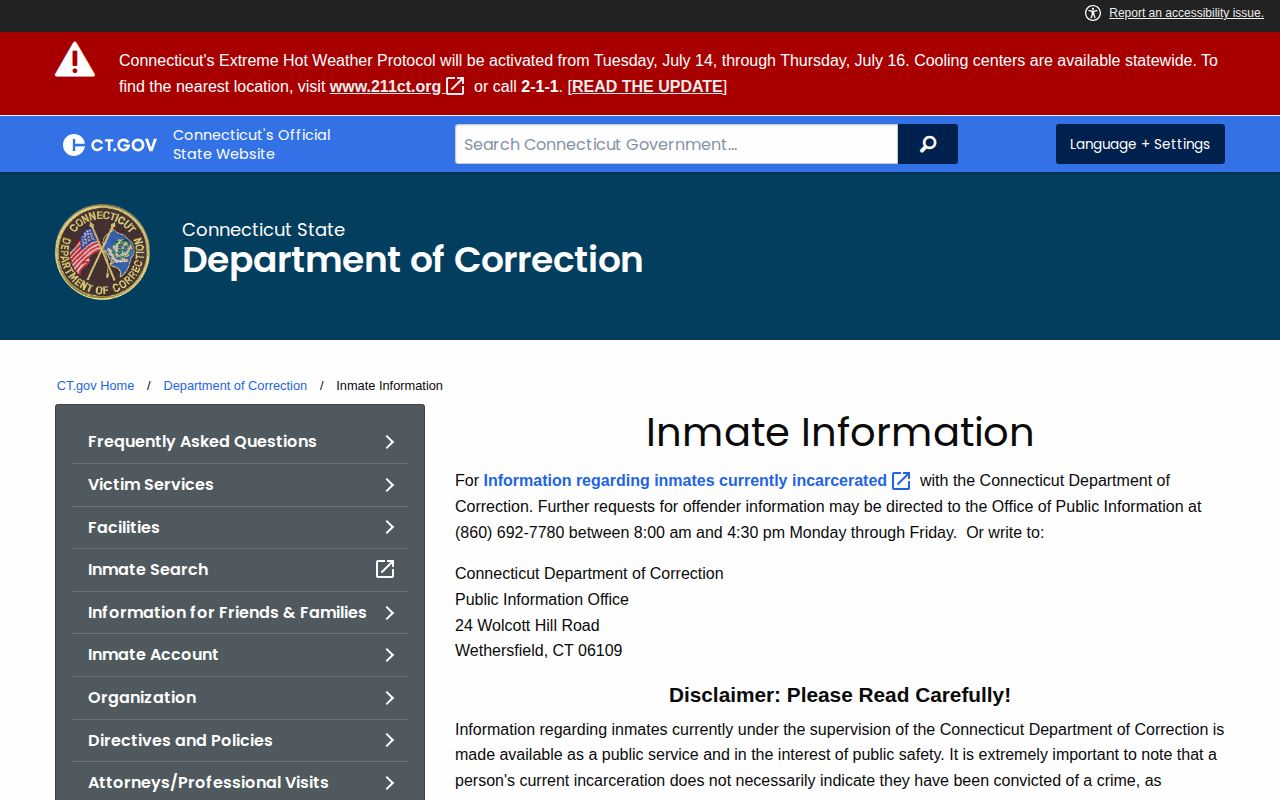
The official warning supports a simple practice: log each view and seek a source record before assigning an exact release date.
Interpret Middlesex Release Changes
A status change does not always mean freedom from all custody. Transfer means movement to another facility or authority. Remand means a court ordered the person into custody. A detainer is a legal hold or request by another jurisdiction. Parole means release from incarceration to community supervision. Probation is court supervision and may follow a suspended sentence or another disposition.
| Observed change | What it may mean | Next check |
|---|---|---|
| Facility disappears | Release, transfer, discharge, exclusion, or data change | CT DOC Public Information and court docket |
| Parole or special parole appears | Release to DOC-related supervision | CT DOC and BOPP |
| Bond or disposition posts | Legal basis for a possible release | Holding facility or CT DOC |
| Past federal release date, no BOP facility | No longer in BOP custody under BOP’s rule | Check other jurisdictions only if relevant |
One docket can close while another keeps the person in custody. The state correctional result answers a different question than the court record. Use both for a Middlesex County release tied to Middletown proceedings.
Confirm Middlesex Three-Day Releases
For written confirmation, send a focused request to CT DOC External Affairs Freedom of Information. Ask for records sufficient to show the person’s custody status, release date, release reason or type, and releasing facility. Supply the full name, CT DOC number if known, date of birth if known, Middlesex docket, facility, and the three-day date range.
The office lists 24 Wolcott Hill Road, Wethersfield, CT 06109, phone (860) 692-6290, fax (860) 692-7873, and an online request portal. For the legal event, the Middlesex Judicial District Chief Clerk’s Office is at 1 Court Street, Middletown, CT 06457, phone (860) 343-6400. Ask for a public docket, bond order, disposition, sentencing order, or mittimus. A mittimus is the court document directing custody or sentence execution.
CT DOC Public Information also lists (860) 692-7780 for further offender information during its weekday hours of 8:00 a.m. to 4:30 p.m. A phone answer can help resolve which unit holds the record, but it should not be stretched beyond what the office confirms. When the three-day sequence includes a parole event, compare CT DOC status with the Board of Pardons and Paroles. A voted-to-parole date is an on-or-after date, so the actual physical release may occur later.
Use the Federal Bureau of Prisons locator only for a federal sentence. Use the ICE detainee locator only when there is a sound reason to check immigration custody. CT DOC expressly excludes federal immigration custody from its inmate database, so a missing state result cannot be used to infer where the person went.
Note: Third-party recent-release pages may copy or guess at old data, so confirm every claim with CT DOC, the court, VINE, or federal records.